
"Welcome to your new doctor’s office — it has dumbbells, DNA tests, and a sauna."
Across the globe, a new breed of gym is emerging. These aren’t just places to sweat. They’re centers of excellence for human performance, combining diagnostics, recovery, lifestyle medicine, personalized training, and education into one seamless ecosystem.
The screenshots you shared hint at this shift: words like comprehensive, educated, high-end, and accountable dominate. This isn’t a trend — it’s a tectonic shift.
And it’s redefining what we mean by “healthcare.”
The Problem: Healthcare Treats Sickness. Super Gyms Optimize Health.
Traditional healthcare is:
Reactive
Fragmented
Rushed
Based on illness
Super gyms flip the model:
Proactive
Integrated
Data-driven
Wellness-first
In these spaces, prevention is not a brochure at the doctor’s office, it’s baked into your weekly training schedule. Blood panels. Movement screens. Recovery metrics. Longevity consults. All part of the membership.
We're not talking about boutique classes or trendy biohacks. We’re talking about a new model of medicine, rooted in daily practice, continuous monitoring, and performance metrics.
Industry Signals: The Numbers Behind the Movement
The global wellness economy is now valued at $5.6 trillion, with fitness, nutrition, and preventive health comprising the fastest-growing segments (GWI, 2024).
Private equity firms are pouring billions into integrated fitness-health concepts (e.g., Equinox, Lifeforce, Levels).
Over 72% of millennials and Gen Z believe wellness should be "a personalized system integrating physical, mental, and nutritional health" (McKinsey Wellness Survey).
This is not an “upgrade” of the gym. This is the reconstruction of primary care, led not by hospitals — but by gyms, coaches, and health-obsessed communities.
Anatomy of a Super Gym: What Makes It “Comprehensive”?
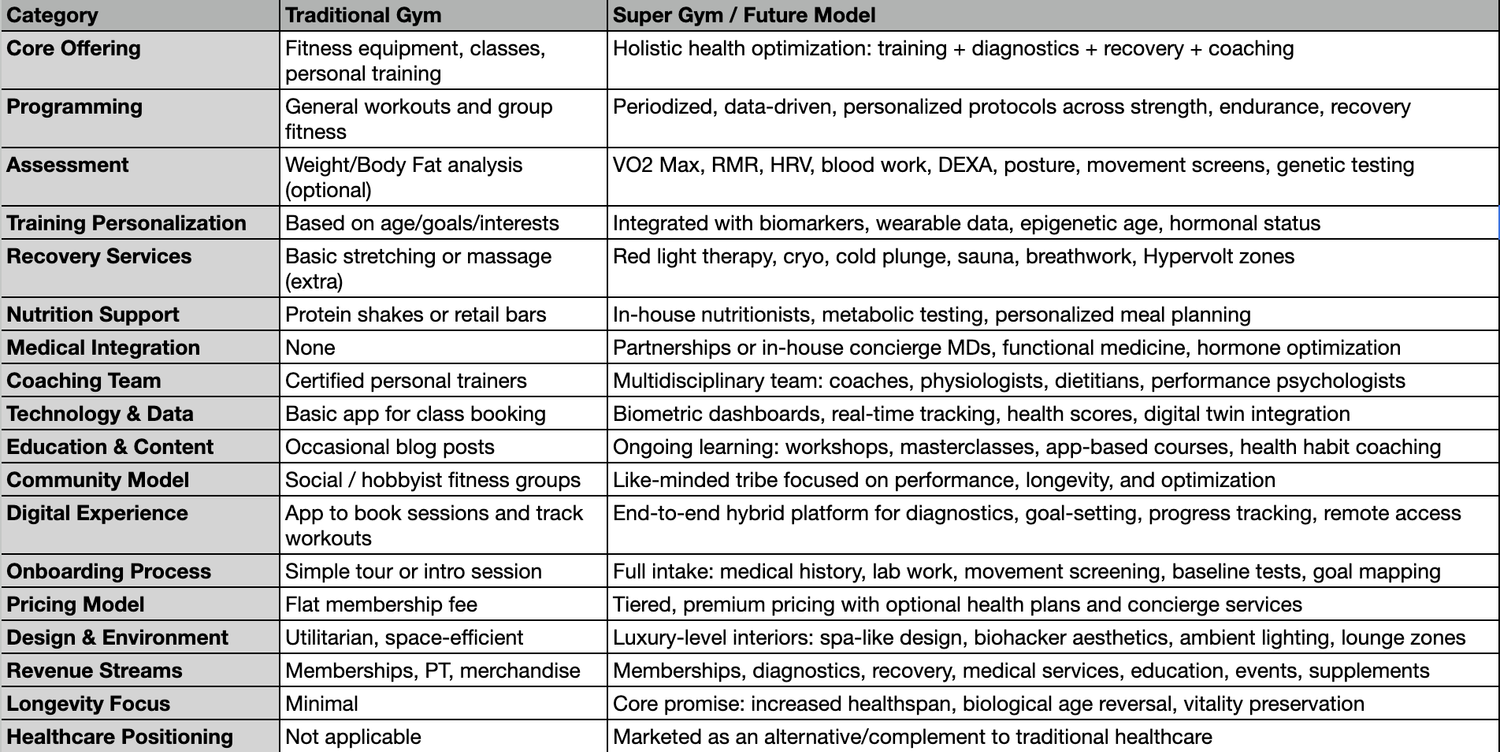
From my two decades working at the intersection of elite sport, fitness, and health tech, I’ve seen first-hand what sets these facilities apart. Here’s the new blueprint:
These aren't just gyms. They’re ecosystems. Hubs for longevity and vitality. Platforms for continuous transformation.
Case Study 1: KĒPOS Health (Austin, TX)
Founded by former strength coaches and health entrepreneurs, KĒPOS blends:
Precision diagnostics
Periodized training
Educational masterclasses
Personal physicians
Members join for performance, but they stay for the self-awareness. Their motto: “Train with intention. Live with clarity.”
The result? A retention rate over 85%, and a waiting list for new members.
Case Study 2: Lifeforce x Equinox
Lifeforce is bringing clinical-grade biomarker tracking to high-end gyms. Partnering with Equinox, they offer:
Hormone panels
Biological age scoring
Monthly consultations
This is lab work as lifestyle. You train hard — but now you also know why it’s working.
It’s the gym-meets-clinic hybrid. No waiting rooms. No white coats. Just world-class support — in the locker room.
Case Study 3: Life Time — The Blueprint for the Luxury Super Gym Model
Life Time Fitness isn’t just a gym chain anymore. It’s an integrated health and lifestyle company — one that sits at the intersection of fitness, wellness, recovery, education, and even real estate.
With over 170 locations across North America, and a growing footprint in Life Time Living (residential communities), the brand represents one of the most ambitious and successful examples of the super gym revolution.
What Makes Life Time Different?
Let’s break it down across 6 key dimensions:
Dimension Execution at Life TimePhysical Infrastructure
Expansive clubs with 100,000+ sq ft of premium training spaces, pools, tennis, spas, and cafés — built like resorts, not gyms.
Integrated Services
In-house chiropractors, physical therapists, nutritionists, and hormone specialists — all accessible on-site or via their platform.
Membership Tiers
Premium tiers offer advanced biometric testing, lab work, concierge wellness services, and VIP coaching.
Recovery + Longevity
Life Time offers Hyperice stations, infrared saunas, cryotherapy, compression boots, red light therapy, and guided recovery rooms.
Education
Member-exclusive content platforms, expert seminars, and health courses on everything from gut health to biohacking.
Digital Integration
Their app tracks fitness, books recovery sessions, schedules coaching, and integrates wearable data for a true hybrid experience.
This is not the 24-Hour Fitness model.
This is destination wellness, backed by lifestyle branding and holistic health strategy.
Life Time’s Business Playbook
Here’s what makes their approach so strategically sharp — and why every performance-focused fitness entrepreneur should take note:
1. Wellness as a Utility
Life Time doesn’t just want to be a place you go for an hour a day. It wants to be woven into how you live.
Their “Life Time Living” developments combine luxury apartments with attached athletic clubs. It’s not theoretical — it’s real estate-backed, recurring-revenue wellness.
This is vertical integration of lifestyle. Your gym is your grocery store, your recovery center, your coffee shop, your social hub.
“You don’t have to go to Life Time. You live inside it.”
2. Audience: The High-Performance Affluent Consumer
Life Time doesn’t compete on price. It competes on value, outcomes, and sophistication.
Its core user is:
Health-literate
Results-focused
Time-sensitive
Willing to pay for access, exclusivity, and personalization
These are the same individuals investing in concierge medicine, functional diagnostics, and longevity clinics. Life Time simply makes it more accessible, more consistent, and more community-driven.
3. Revenue Diversification
Life Time monetizes through:
Memberships (monthly recurring revenue)
Personal training and coaching
Nutritional and recovery services
Family programming (childcare, summer camps)
Café and lifestyle retail
Events, races, and corporate wellness partnerships
Each vertical enhances retention, deepens the consumer relationship, and expands lifetime value.
What Fitness Brands Can Learn from Life Time
If you're building or evolving a wellness business, take these five lessons from Life Time's playbook:
Design for Lifestyle, Not Occasions → Build spaces and services that invite daily integration, not occasional visits.
Elevate the Environment → Aesthetic, spacious, high-end experiences increase perceived value and foster emotional attachment.
Bundle Services for Behavior Change → Don’t just offer fitness. Offer tools, teams, and touchpoints that move the needle across the full healthspan.
Own the Consumer’s Data + Narrative → Help your members visualize their transformation — not just with photos, but with insights, dashboards, and diagnostics.
Move from Membership to Mentorship → Your trainers are not just coaches. They are guides. Educators. Accountability partners. Position them that way.
Strategy Framework: How to Build a Super Gym Model
Whether you're a brand operator, investor, or innovator, here’s a framework I’ve developed through my work at World Gym, Technogym, and Power Plate — one that helps transition traditional gyms into performance-health centers:
The 5-P Super Gym Model
Personalization → DNA, blood, and biomechanical insights create bespoke programs
Programming → Training, recovery, and mindset cycles integrated for longevity, not just aesthetics
Partnerships → Strategic alliances with labs, medtech, supplements, and wearables to elevate offering
Platformization → Use technology to track progress, enable remote coaching, and visualize impact
People → Hire credentialed professionals (coaches, nutritionists, rehab specialists) who educate, not just instruct
Why It Matters for the Future of Fitness and Healthcare
As governments struggle with sick-care models, the private sector is quietly building the next generation of proactive health infrastructure. These gyms:
Reduce healthcare costs
Boost productivity
Improve life span and health span
It’s no longer about six-packs. It’s about being biologically younger at 60 than your dad was at 40.

Personal Insight: From Marketing Fitness to Designing Health Systems
In my time leading marketing for global sports and wellness brands, I’ve seen the limits of transactional models. The future isn’t about selling memberships.
It’s about:
Building trust.
Delivering transformation.
Educating people to take ownership of their health.
Consumers are ready. Investors are ready. The question is — are we?
Conclusion: The Gym is the new Escape the Hospital card!
But it doesn’t feel like one. It’s vibrant. Aspirational. Driven by performance, not prescriptions.
And make no mistake: the brands that embrace this shift — those that create comprehensive, accountable, and high-end wellness ecosystems — will not just thrive.
They’ll own the future of healthcare.
Let’s Build the Future Together
Are you building a brand or space that wants to lead in this new health paradigm?
Let’s talk. From developing your strategic roadmap to designing your go-to-market engine, I help performance-forward businesses scale smarter and connect deeper.
DM me for a consult or visit www.tomdievart.com to explore consulting opportunities.
#FitnessInnovation #HealthspanRevolution #WellnessDesign #SuperGym #FutureOfHealthcare #PerformanceStrategy #marketing #branding #consulting